

Theories and Computational Methods for Quantum Transitions in Light Energy Conversion, Imaging, and Sensing

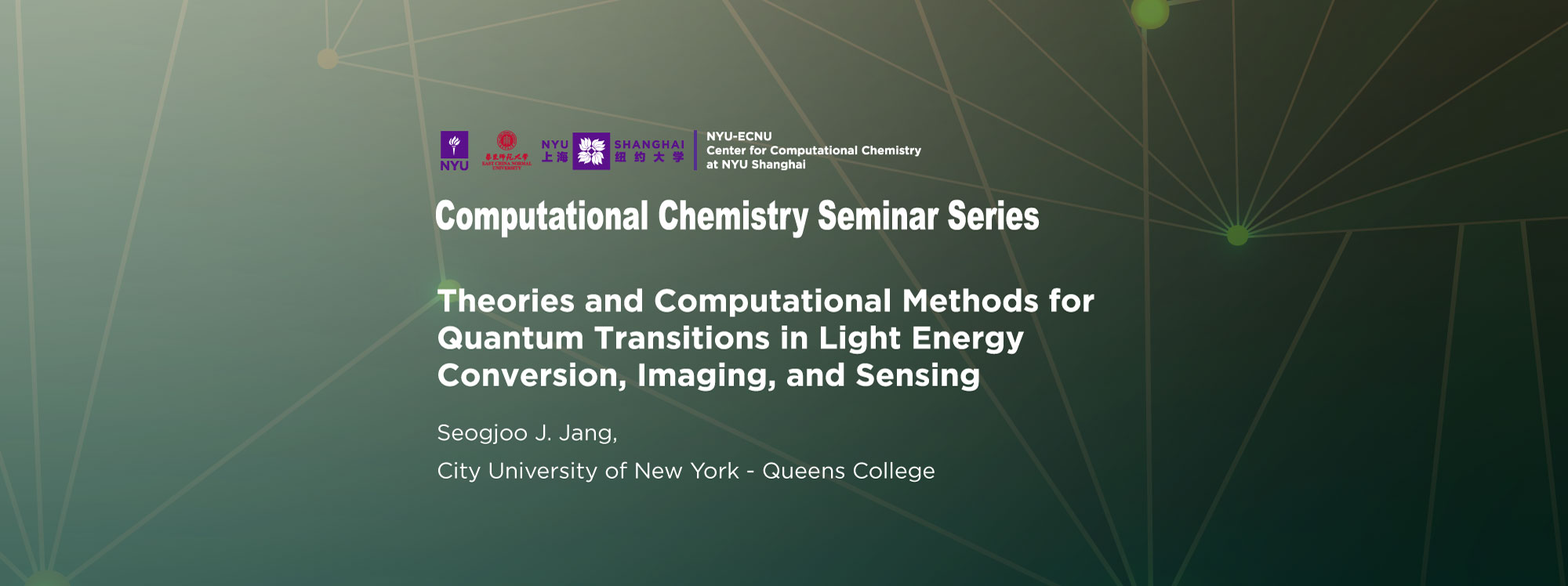
Theories and Computational Methods for Quantum Transitions in Light Energy Conversion, Imaging, and Sensing
Topic
Theories and Computational Methods for Quantum Transitions in Light Energy Conversion, Imaging, and Sensing
Date & Time
Thursday, July 23, 2026 - 16:00 - 17:00
Speaker
Seogjoo J. Jang, City University of New York - Queens College
Location
Room E620, NYU Shanghai New Bund Campus & Hosted via Zoom (Meeting ID: 936 1870 0135; Passcode: 592773)

- RSVP if attending onsite -

- Join via Zoom -

Abstract:

Great advances have been made over many decades in characterizing electronic excited states and their quantum transitions in complex molecular environments. Depending on the nature of the system and its environments, these quantum transitions can be described either by rates or through a more complete quantum dynamical treatment. For calculating rates of exciton transfer and decay, Fermi's golden rule (FGR) has been widely and successfully used to describe many molecular systems.  However, when applied to complex molecular systems, FGR faces some ambiguities and limitations that call for further refinement and development.
 
In this talk, I will present our recently developed quantum rate theories for resonance energy transfer and nonradiative decay, which reveal quantum effects that were absent in previously established theories.  Applications to photosynthetic light harvesting complexes and organic dye molecules demonstrate how these improved theories enable more accurate and quantitative description of exciton transfer and nonradiative decay rates.
 
For transitions that cannot be fully captured by rates alone, more advanced quantum dynamics approaches are needed. To this end, we have been developing a range of open-system quantum dynamics methods, including polaron-transformed quantum master equation approaches. The implications and utility of these methods for driven open system quantum dynamics processes, such as those relevant to quantum sensing, will also be discussed.
 

Biography:

Dr. Seogjoo J. Jang is a professor of chemistry at Queens College of the City University of New York (CUNY), and a doctoral faculty of both Chemistry and Physics PhD programs at the Graduate Center of CUNY. He has also been serving as a Korea Institute for Advanced Study (KIAS) Scholar since 2022. Dr. Jang received BS (89) and MS (93) degrees in Chemistry from Seoul National University, and PhD degree in Chemistry (1999) from the University of Pennsylvania under the supervision of Gregory A. Voth. He worked as a postdoctoral associate at MIT during 1999-2002 (working with the late Bob Silbey and also Jianshu Cao), and as a Goldhaber Distinguished Fellow at Brookhaven National Laboratory (working with Marshall D. Newton) in 2003-2005. Since starting as an assistant professor at Queens College in 2005, Dr. Jang was granted an early promotion to an associate professor in 2009, tenured in 2010, promoted to a full professor in 2012, and served as the chair of the department during 2018-2021. He is a recipient of the NSF CAREER Award (2009) and Camille Dreyfus Teacher Scholar Award (2010).  Dr. Jang's main research expertise is in the development of theories and computational methods for quantum dynamics in complex molecular systems, with particular focus on exciton and electron dynamics. These have significant implications for solar light harvesting, sensing, and imaging, and have mostly been supported by both NSF and the Department of Energy.

Seminar Series by the NYU-ECNU Center for Computational Chemistry at NYU Shanghai

This event is open to the NYU Shanghai, NYU, ECNU community and the computational chemistry community.