


Abstract:
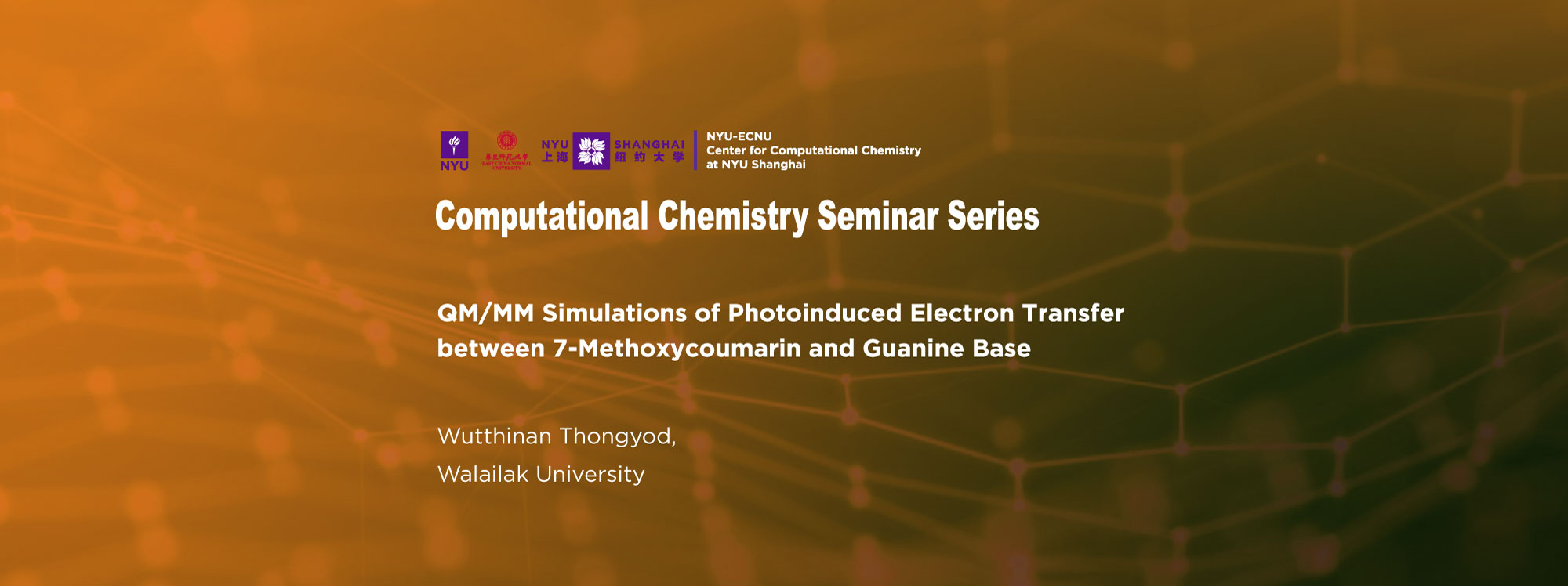
Photoinduced electron transfer between fluorescent dyes and DNA bases is a fundamental mechanism utilized in the design of optical biosensors. While guanine is well-known to be the most effective electron donor among nucleic acid bases, the precise atomistic trajectories that govern fluorescence quenching remain complex. This work synthesizes findings from a computational study using hybrid quantum mechanical/molecular mechanical simulations to elucidate these dynamics, with a primary focus on the role of hydrogen bonding in the 7-methoxycoumarin (7MC) system. The primary investigation focuses on the interaction between 7MC and a single guanine base (Gua). Using the full multiple spawning method to simulate excited-state dynamics, the study reveals that the quenching mechanism is heavily dependent on specific intermolecular geometries. Simulations for the 7MC-Gua complex indicate that electron transfer effectively occurs on the second excited state. The efficiency of this charge transfer is modulated by two critical geometric factors: intermolecular planarity and hydrogen bond length. The study identifies a distinct proton-coupled electron transfer mechanism at short hydrogen bond distances (~1.0 Å). In this regime, the transfer of an electron from guanine to 7MC is accompanied by the simultaneous transfer of a proton, a phenomenon that significantly alters the chemical nature of the quenching event. These results suggest that hydrogen bonds do not merely anchor the dye but actively facilitate the electronic coupling required for quenching. Whether driven by the specific hydrogen-bond network in the 7MC-Gua complex, understanding these distinct pathways is essential for engineering highly sensitive DNA probes.
Biography:
Wutthinan Thongyod is currently a lecturer at the School of Science, Walailak University, Nakhon Si Thammarat, Thailand. He completed his B.Sc. and Ph.D. in Physics from Prince of Songkla University under the supervisions of Assoc. Prof. Dr. Teparksorn Pengpan, Asst. Prof. Dr. Chutintorn Punwong and Assoc. Prof. Dr. Chittanon Buranachai. During his graduate training, he was awarded the 2019 NYU Shanghai Student Research Program in Molecular Science (SRPMS) Program for overseas short-term research, which he joined the research group of Assoc. Prof. Dr. William J. Glover at New York University Shanghai, China. His current research interests focus on the molecular photophysics and photochemistry of fluorophores and chromophores in different environments obtained from the excited-state dynamics simulations using the Full Multiple Spawning (FMS) method coupled with a hybrid quantum mechanics/molecular mechanics (QM/MM) approach.
Seminar Series by the NYU-ECNU Center for Computational Chemistry at NYU Shanghai
This event is open to the NYU Shanghai, NYU, ECNU community and the computational chemistry community.