- RSVP if attending onsite -
- Join via Zoom -
Abstract:
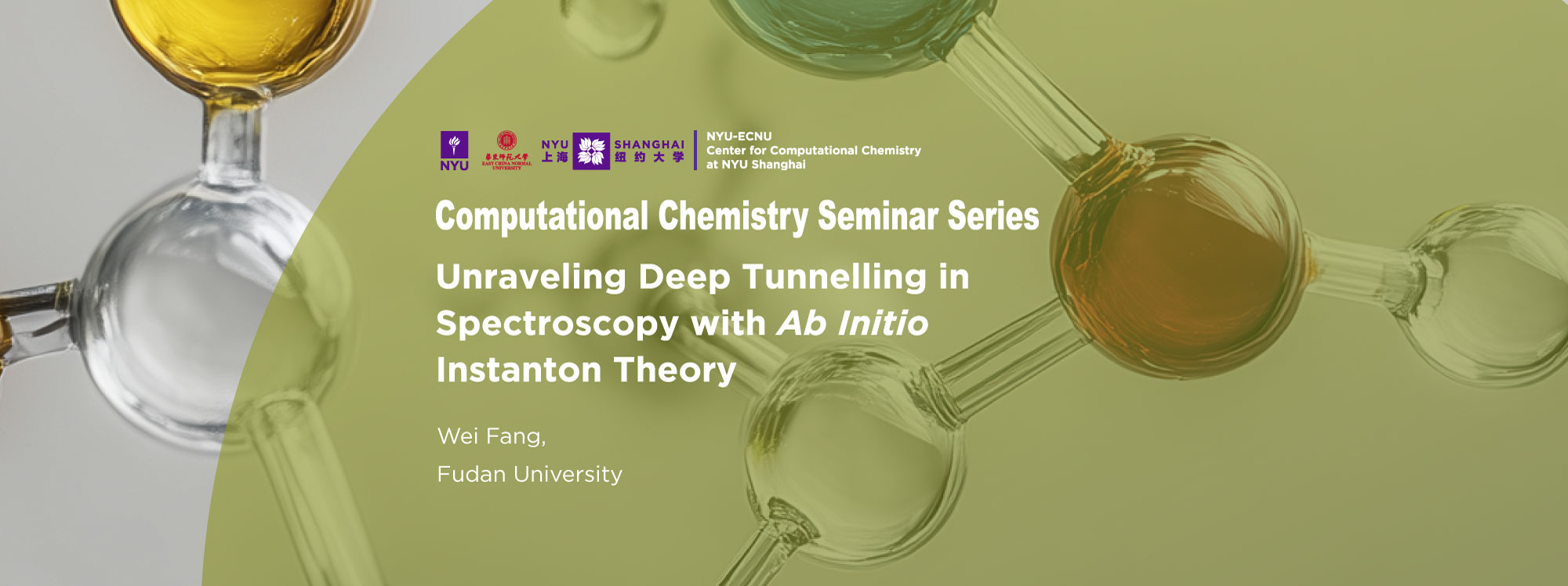
Theoretical prediction of reaction rates is crucial in many fields. The widely used classical Transition State Theory (TST) provides a highly effective method for calculating reaction rates, but it cannot describe quantum tunneling. Ring-polymer instanton theory is a rate theory formally similar to TST that incorporates nuclear quantum effects such as tunneling. It can be combined with first-principles methods to understand tunneling phenomena in chemical reactions of larger molecules. Here, I will report on some progress we have made over the past few years in tunneling simulations by integrating instanton theory, high-precision electronic structure calculations, and machine learning-assisted tunneling path optimization algorithms. For example, we theoretically reproduced the significant 16O/18O isotope effect observed in matrix isolation spectroscopy experiments, providing strong theoretical support for oxygen atom tunneling. We also simulated the "fingerprints" (tunneling splitting) left by heavy atom and molecular tunneling in molecular rotational spectra. Beyond chemical reactions under the Born-Oppenheimer approximation, instanton theory can also be applied to explore tunneling phenomena in nonadiabatic chemical reactions under the Fermi's Golden Rule limit. I will also discuss our recent developments on understanding tunneling in the Golden Rule regime.
Biography:
Wei Fang graduated from Peking University in 2013 with a Bachelor's degree in physics and earned his Ph.D. degree at University College London (UCL) in 2017. From 2018 to 2020, he served as a postdoctoral researcher at ETH Zurich, Switzerland. He then worked as a visiting scholar at the Dalian Institute of Chemical Physics, Chinese Academy of Sciences, from 2021 to 2022. In 2022, he joined Fudan University as an associate researcher at the department of chemistry, where he conducts research in molecular simulations within the field of physical chemistry. Wei's main research interest focuses on understanding nuclear quantum effects and the development of path integral based methods.
Seminar Series by the NYU-ECNU Center for Computational Chemistry at NYU Shanghai
This event is open to the NYU Shanghai, NYU, ECNU community and the computational chemistry community.