


Abstract:
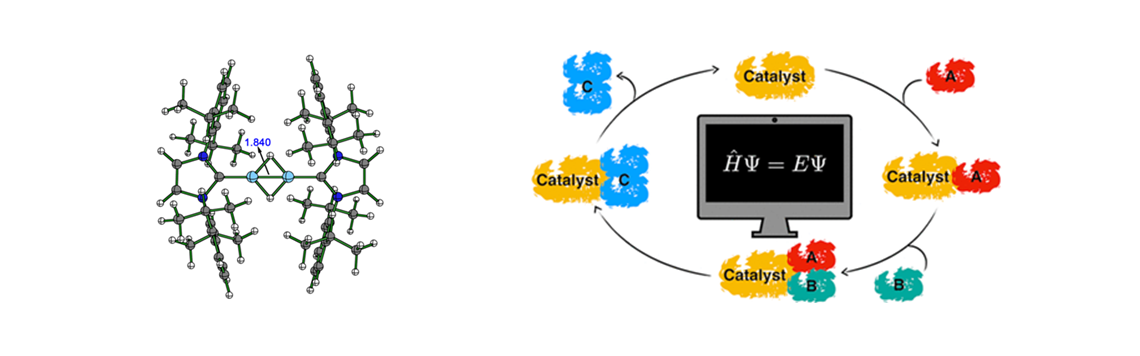
We employ computational tools to design novel organometallic molecules and investigate organometallic catalysis. Our work addresses experimental–theoretical synergy, generating new insights and ideas to aid and guide experimental research. In this seminar, I will discuss the design of zero- and low-valent metal-metal bonded complexes and the mechanisms of transition metal-catalyzed synthetically useful organic reactions, including olefin metathesis, C–H bond activation, hydroformylation, and C–C cross-coupling.
References
1. Zhang, L.; Cheng, K.; Wang, X.;* Chu, J.* J. Am. Chem. Soc. 2025, 147, 25017–25023.
2. Qiu, C.; Liu, L.; Wang, X.;* Gong, H.* J. Am. Chem. Soc. 2025, 147, 17251–17259.
3. Zhao, X.; Zhang, D.;* Wang, X.* ACS Catal. 2022, 12, 1809–1817.
4. Guo, J.; Zhang, D.; Wang, X.* ACS Catal. 2020, 10, 13551–13559.
5. Yuan, C.; Zhao, X.-F.; Wu, Y.-B.;* Wang, X.* Angew. Chem. Int. Ed. 2016, 55, 15651–15655.
Biography:
Dr. Xiaotai Wang studied chemistry as an undergraduate and Master's student at Hefei Normal University and the University of Science and Technology of China, respectively. He received his PhD in chemistry from the University of Virginia in 1994. Following postdoctoral research at the University of Utah and Iowa State University, he started his independent career at the University of Colorado Denver in 1997, advancing from Assistant to Associate to Full Professor. Dr. Wang has served as a visiting scholar/professor at prestigious institutions including MIT and the Chinese Academy of Sciences. Dr. Wang joined Xi'an Jiaotong-Liverpool University (XJTLU) as Professor of Chemistry in November 2022.
Seminar Series by the NYU-ECNU Center for Computational Chemistry at NYU Shanghai
This event is open to the NYU Shanghai, NYU, ECNU community and the computational chemistry community.